10 years of TECH.LAND: From a naive start to a regional powerhouse. We scale startups through curated matchmaking and high-impact networking.
After 10 years, it’s time for an update. Looking at the TECH.LAND Accelerator today is like looking back on a journey that began in 2017 with a dose of naivety and a whole lot of passion in the Münsterland region. Back then, when we launched the first call for the "Digital Hub Accelerator," we held our breath: would anyone even apply? In the end, we were able to select two startups for the first batch.
Fast forward nearly a decade, and the world has kept spinning. Those first steps have grown into an established center for the regional digital economy and startups. In our last review at the end of 2022, we took stock of 36 teams. Today, in 2026, we’ve reached a point where we’re no longer just talking about "initial aid," but about scaling, successful collaborations, exits, and a mature innovation landscape that is sustainably shaping Münsterland and the EUREGIO.
1. How do you measure the success of an accelerator program?
A program that lasts for over ten years—despite pandemics, energy crises, and the bursting of various hype bubbles (Metaverse, anyone?), is already a guarantee of quality simply by existing. But consistency isn't an end in itself. Naturally, we measure ourselves against hard facts and the question: are we creating real economic value for the region?
Here are a few facts and figures for you:
- Funding: In recent years, startups from the accelerator have raised a total of over 50 million euros in external capital.
- Survival Rate: Out of a total of 59 companies that have gone through the accelerator since 2017, 42 are still successfully active. 86% of the startups were still successfully on the market two years after completing the program.
- Employment Effect: We estimate that the alumni teams employ approximately 500 people, many of them in future-oriented industries and work areas.
Some have already successfully moved past the startup stage. One example is FunnelBridge from Münster. The team used their time in the program to specifically sharpen their growth and market positioning. The company developed a solution for integrating WhatsApp into recruiting processes and was later successfully sold to the international HR tech company Tellent. Founder Simon Wagner looks back on this phase:
Our expectations were exceeded. During the six months in the accelerator, we were able to significantly increase our growth rate and more than double our Annual Recurring Revenue.
Simon Wagner, Founder of FunnelBridge
However, if we’re being honest: one of the most effective ways to optimize accelerator metrics is the selection of teams. A good accelerator isn't a safety net; it’s a potential multiplier. That’s why great programs are characterized by the fact that they attract significantly more applications than there are spots available. Our selection rate for the TECH.LAND Accelerator is well below 50%. Most applications fail at one specific point: the Minimum Viable Product (MVP). For a successful collaboration between a startup and a medium-sized company (Mittelstand), a market-ready MVP is a crucial building block. Without a tangible product, the risk increases that potentially successful collaborations are ruled out from the start because the startup hasn't yet translated its vision into something graspable.
Among the most successful accelerator alumni teams are the startups clockin and Pacurion, both of which were accepted into the statewide NRW elite program scale-up.nrw. Startup scaling remains an "outlier game," meaning overall success isn't determined by the average of all participants, but by a few extremely successful outliers. Our share in the success of these companies remains vanishingly small, but in this game, every extra percentage point of probability can be helpful in crossing that critical threshold.
2. Matchmaking as the program's core USP
There are now many accelerator programs in Germany and NRW. Many of them advertise—quite rightly—high-class mentoring promises. However, especially in the selection process of the NRW Hubs, one unique selling point of our program has clearly emerged: matchmaking with established companies. This component of the TECH.LAND Accelerator builds on the substance of the Digital Hub münsterLAND and focuses on promoting cooperation between startups and medium-sized enterprises. We’re not just talking about a simple exchange of email addresses here. An intro from us must be a curated recommendation. We know the needs of our member companies and partners and know where a collaboration, a pilot project, or a strategic partnership actually makes sense.
We don't just want to give clever advice; we want to actively work on the team's success. Countless emails are written and intros are initiated during each batch. Especially in early growth phases, this access is crucial. The HealthTech startup SaniUp (Batch 22), which automates digital billing processes for medical supply stores, is a great example:
To be honest, we had low expectations for the matchmaking because our topic is very niche. We were all the more surprised at how quickly we gained relevant corporate contacts through the network.
Tim Rothenpieler, CTO SaniUp
This approach is fueled by the current momentum for Venture Clienting. Thanks to new AI tools, startup sourcing is becoming increasingly feasible even for the small and medium-sized enterprises that make up a large part of our network. We moderate this process and ensure that both sides speak the same language. Co-founder Silke Sommer from the GovTech startup comuneo summarizes it this way:
The direct exchange with companies and public actors helped us to develop our solution in a practical way and to open up new fields of application.
Silke Sommer, Co-Founder of comuneo
3. No two teams are alike — and neither is the program experience
After over 50 teams, we can say: everything is different. Particularly in the scale-up phase, the teams differentiate themselves significantly. This brings us to a point that sounds paradoxical at first: our favorite teams are the ones that actually have no time for us. Why? Because they are with the customer. Because they are working on the product. Instead of sitting in workshops. Our task then is to prepare a bi-weekly 60-minute meeting in such a way that it brings dedicated value, so the founders can return to their daily business with maximum output. To achieve this, we create flexible, needs-oriented formats: sometimes it’s targeted Deep Dives on topics like strategy or Go-to-Market, sometimes a curated peer-to-peer format, such as an AI meetup specifically for CTOs. The offering evolves dynamically along with the needs of the teams in the program.
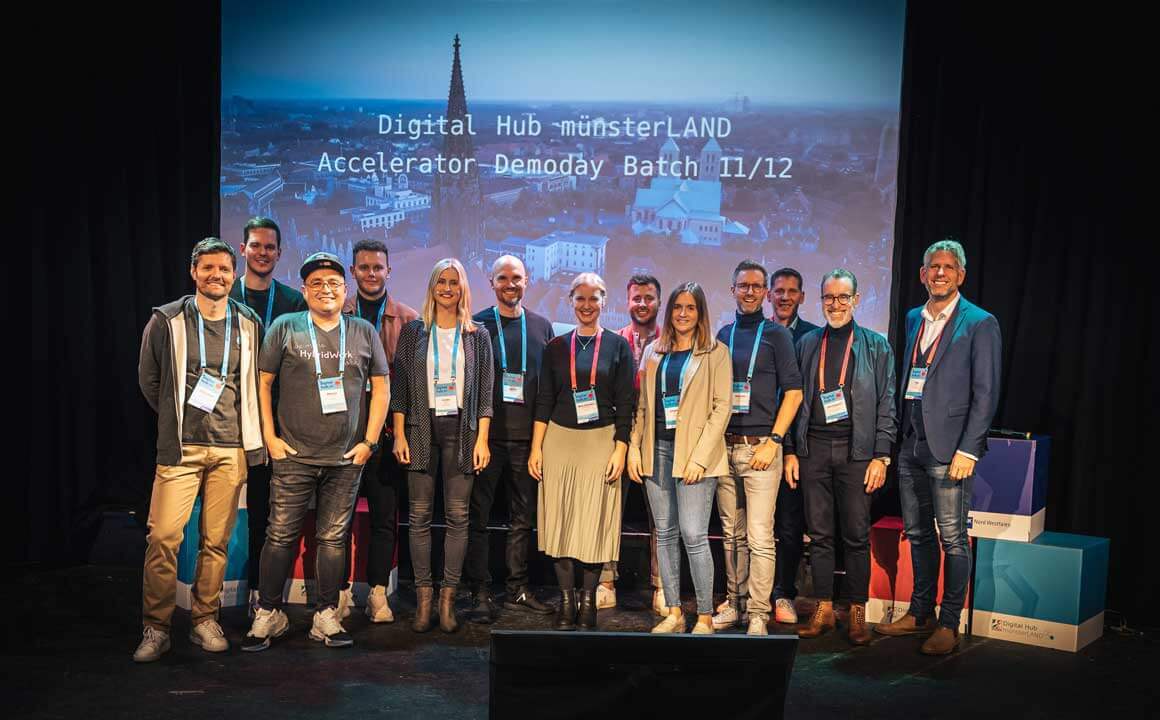
In the scaling phase, however, the time for "stealth mode" is usually over. Anyone who wants to scale needs visibility. The accelerator acts as a megaphone here. We specifically place startups on statewide stages via our high-reach network in NRW. A central element is the Accelerator Demoday, where teams present their progress to companies, investors, and business angels. As part of the statewide network of NRW Hubs, we can open special doors for all teams. With syte, Pacurion, and comuneo, three accelerator teams have already made it into the top 3 of the state prize "Outofthebox.nrw." Founder Dominik Leufgen from the startup Pacurion describes how decisive this factor was for them:
The program helped us enormously, especially with public relations in the Münsterland region. We gained many customers and contacts there and were able to use valuable sparring—for example, when preparing our financing round at the time.
Dominik Leufgen, Founder of Pacurion
One program, many paths
The stories so far show: there isn't just one path to success. With the relaunch of the TECH.LAND Accelerator, all these success stories are now available in one place on our website. There you will find profiles, collaborations, and experience reports that provide an impression of the program sequence and its successes. We look forward to your application!